русский
 عربى



A valve on a cooling water line closes every evening and holds without a drip. A similar valve on a hot process line weeps a little each week, and the seat looks hard and cracked. Both bodies are stainless steel. The difference sits in the seat, and in how well it suits the fluid, temperature, and duty.
For a Stainless Butterfly valve, the sealing design shapes leakage, service life, and maintenance. Here is how soft and metal seats differ, and how to match one to your operating conditions.
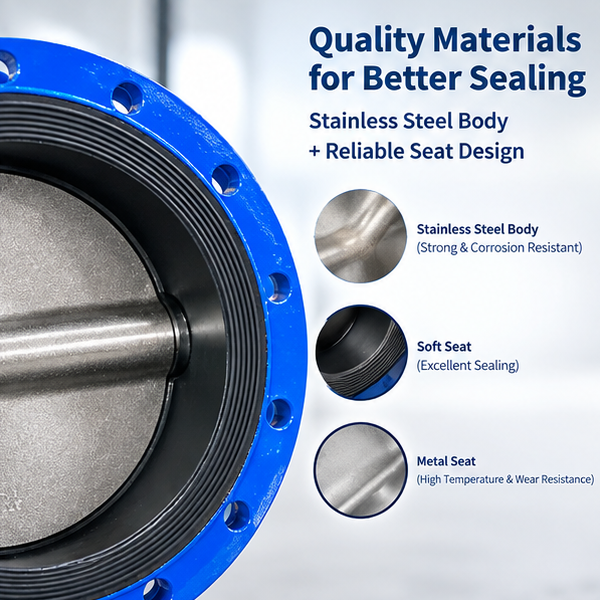
A butterfly valve turns a disc inside the pipe to allow, restrict, or stop flow. The stainless body gives structure and corrosion resistance, but it does not decide how well the valve seals. Seat material, disc surface, fluid properties, and closing conditions do.
Two valves that look alike can behave differently on the same line. One suits clean water, another a hot process fluid or a stream carrying particles.
| Design Factor | Why It Matters |
|---|---|
| Seat material | Sets sealing behavior and operating limits |
| Disc surface | Affects contact with the seat |
| Fluid properties | Influence wear, corrosion, and sealing |
| Temperature | Decides whether the seat material stays suitable |
| Closing conditions | Change contact between sealing surfaces |
| Maintenance access | Shapes inspection and service planning |
Weigh these together. Looking only at the body material or the seat label leaves gaps.
A soft seat uses a resilient material, often an elastomer or another non-metallic compound. When the valve closes, the disc presses into the seat, and the material flexes to fill small surface variations. This often gives tight shutoff on water, air, and many general fluids when the seat suits the conditions.
"Soft seat" is not one material. A compound that works with one fluid may swell, harden, soften, or crack with another. Check fluid composition, temperature, pressure, and cleaning routines before choosing.
Limits appear when conditions exceed the material. Heat changes flexibility, some chemicals cause swelling or breakdown, and repeated cycling wears the contact surface. Abrasive particles scratch the seat, and a grain trapped between disc and seat can stop full closure.
A metal seat relies on machined metal surfaces meeting when the valve closes. It is often considered where resilient materials struggle, such as higher temperatures, abrasive media, or demanding duty. The details depend on the design and material pairing.
Metal-to-metal contact does not mean zero leakage. Results depend on manufacturing quality, surface condition, closing force, and the acceptance requirement. Some processes tolerate a small amount of passing flow, while others do not, and a soft seat may then suit better.
Surface finish and alignment matter. Damage, corrosion, or misalignment raises leakage, so maintenance planning still applies.
| Consideration | Soft Seat | Metal Seat |
|---|---|---|
| Sealing contact | Resilient seat | Metal surfaces |
| Leakage control | Can give tight shutoff when suitable | Depends on design and surface contact |
| Temperature | Limited by seat material | May suit hotter service |
| Fluid compatibility | Depends on seat chemistry | Depends on corrosion resistance and pairing |
| Particles | May cut or obstruct the seat | May wear contact surfaces |
| Maintenance | Seat wear and replacement | Surface condition and alignment |
Treat this as a starting point. Seat compounds and constructions vary, so check the manufacturer's application guidance and documented performance.
Define the shutoff need before choosing a seat. Some lines need near-zero passing flow. Others use the valve mainly for control and accept a defined amount. Consequences matter too: a drip may be a nuisance in one plant and a safety, quality, or environmental issue in another.
Avoid vague phrases like "tight sealing." State the duty, the acceptable leakage, the conditions under which it must hold, and the test requirement. Remember that a new valve and one after months of wear, deposits, or corrosion can differ. For strict limits, verify through documentation instead of assuming a seat category guarantees the result.
Heat can soften or harden resilient seats and change how metal parts expand. Pressure sets the load on the sealing arrangement. Review both together, since permitted limits can shift when they combine. A stainless body does not remove these limits, because the disc, seat, and shaft must also suit the service.
Look beyond steady running. Startup, shutdown, cleaning cycles, and process interruptions can bring temperatures and pressures that normal operation never reaches.
Stainless steel resists corrosion in many environments, but the grade, concentration, and temperature matter, and the seat may react differently from the body. Suspended solids can scratch sealing surfaces, and sticky or deposit-forming fluids can keep the disc from fully closing. If the composition varies during operation, include those changes when you brief the supplier.
A valve cycled many times a day stresses the seat and shaft more than one operated occasionally. A soft seat sees repeated compression and friction. A metal seat sees wear where surfaces meet, especially with abrasive media. Cycle count is only part of the picture, so share the operating pattern, fluid conditions, and maintenance access with the supplier.
A suitable valve can still leak if installed poorly. Misalignment, rough handling, or damaged sealing surfaces change how the disc meets the seat. Pipe loads and movement beyond design limits can shift components, so follow installation instructions and inspect the valve before it goes into service.
Maintenance differs by design. Check soft seats for wear, deformation, or chemical damage. Check metal seats for surface condition, corrosion, alignment, and moving parts. Keep records of leakage, operating difficulty, and repairs. Repeated problems may signal that the selection no longer fits the duty or that the process has changed.
Share unusual conditions before the order is confirmed.
A soft seat often fits where tight shutoff and material compatibility are the priorities. A metal seat is worth evaluating where heat, particles, or duty strain resilient materials, provided the leakage it delivers is acceptable. Clear information on leakage need, fluid, temperature, pressure, cycling, and service access gives a practical basis for comparing each Stainless Butterfly valve option.