русский
 عربى



A cooling loop is commissioned, and the valve that was supposed to throttle gently starts to hum and shake at half-open. The pipe size is correct, the material grade is correct, and the actuator responds. The disc is where the trouble sits. In a Stainless Butterfly Valve, the disc does more than open and close the line. Its thickness, edge profile, and position decide how fluid moves past it, how much resistance builds, and how pressure behaves downstream.
Understanding these details helps engineers match a valve to the piping layout, the medium, and the control duty instead of relying on nominal size alone.
A butterfly valve controls flow with a disc that rotates inside the body. Turning the disc changes the passage available to liquid or gas. In a Stainless Butterfly Valve, disc geometry covers several features that work together:
Changing one feature alters the others. A thicker disc, for example, narrows the passage and reshapes the surrounding flow. Stainless construction adds further demands, since the disc must also provide structural strength, corrosion resistance, and reliable sealing. Flow behavior cannot be the only design driver.
Fluid meeting the disc changes direction and speeds up as it squeezes through the remaining opening. The resulting pattern depends on profile, position, and fluid characteristics.
A thicker disc blocks more of the pipeline when open or partly open. Local velocity rises and pressure shifts around the restriction. A thinner disc leaves more room for flow, but strength, operating pressure, and resistance to deformation limit how thin it can be. The design has to balance flow needs against structural demands.
A conventional profile may cause noticeable changes in direction, which can contribute to flow separation and swirling downstream. A streamlined profile guides fluid differently, though its real effect depends on the valve body, opening position, and nearby piping.
An abrupt edge can produce local changes in velocity and pressure, while a carefully shaped one influences how fluid passes the perimeter. Edge geometry must also be considered with sealing contact, because the disc still has to close reliably.
Pressure drop is the pressure a fluid loses passing through the valve. The disc obstructs the line and alters the direction and speed of the flow, so its geometry contributes directly. Valve opening, fluid properties, and pipeline conditions also play a part.
Fluid accelerates around the opening and then expands behind the disc, which creates distinct pressure regions. A thicker disc increases obstruction, an abrupt profile strengthens direction changes, a narrow opening raises local velocity, and a suitable profile can ease the transition. Pressure loss should be judged across the whole valve, not from how the disc looks.
Turbulence is irregular movement with changing speed and direction. Behind a disc, swirling zones, separated flow, and wakes can form, and they become more pronounced at partial openings. Strong turbulence can cause vibration, noise, unstable control, and extra mechanical stress, which is why disc geometry matters most for valves that regulate frequently, as in the cooling loop above.
Flow capacity describes how much fluid passes under stated conditions. The disc changes the effective opening, but the opening alone does not set the flow rate. Pressure difference, fluid properties, and internal construction all contribute.
Engineers use flow coefficients to relate flow to pressure difference and to support sizing. When evaluating a valve, consider the published flow characteristics, how capacity changes with opening position, the expected pressure difference, the fluid type, and the manufacturer's test conditions.
Even fully open, the disc stays in the flow path and keeps influencing the stream. Two valves of the same external size can behave differently if their discs differ in profile or thickness, so actual performance data is more reliable than nominal pipe size.
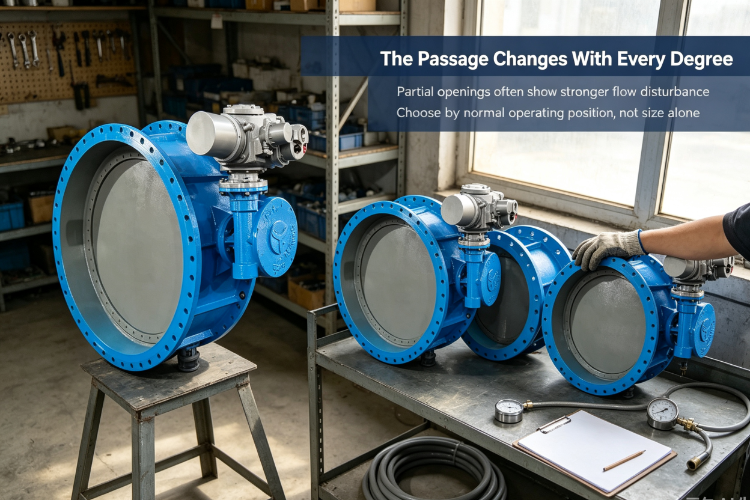
As the disc turns toward closed, the passage shrinks, and velocity, pressure, and turbulence change. The relationship between opening and flow rate is not linear. A partly open valve usually shows stronger disturbances than one near full open, so the normal operating position should guide selection for regulating duty.
Typical applications place different demands on the valve:
No configuration performs identically in every installation. The comparison below shows design considerations only.
| Consideration | Conventional Profile | Streamlined Profile |
|---|---|---|
| Flow passage | Obstructs the pipeline | Shapes the passage around the disc |
| Fluid direction | May cause noticeable changes | Can guide flow through a different transition |
| Flow resistance | Depends on thickness and opening | Depends on profile and internal geometry |
| Structural needs | Must withstand operating loads | Must also keep adequate strength |
| Suitability | Depends on intended service | Depends on required flow and control |
Conventional discs balance strength, sealing contact, manufacturability, and control, and may create local restrictions and downstream disturbance. Streamlined discs shape the surface to influence how fluid moves around it, and may help manage separation and wake. A streamlined look does not guarantee lower pressure loss, since results depend on the complete assembly.
Strength remains essential. The disc withstands fluid forces and repeated movement, so reducing material or changing the profile affects structural behavior. Flow characteristics have to be weighed against stiffness, shaft connection, sealing contact, and material compatibility.
| Step | What to Review |
|---|---|
| Flow and pressure | Required flow rate, normal and changing demand, acceptable pressure loss |
| Fluid | Liquid or gas, suspended particles, viscosity changes, corrosiveness, temperature |
| Duty | Isolation versus frequent adjustment |
| Construction | Body, shaft, seat, connection, actuation, environment |
Fluid properties influence the stainless grade, disc construction, and sealing material. Isolation duty places weight on sealing and durability, while regulating duty puts opening characteristics, pressure loss, and flow stability first. A review of the complete valve prevents decisions based on one component.
Yes. The body defines the internal passage, and its dimensions and surface transitions affect how the disc interacts with the surroundings. The shaft links the disc to the actuator and must allow stable movement without compromising strength. The seat supports sealing and must suit the medium, temperature, and pressure. Surface finish and dimensional consistency influence how internal parts fit and how repeatable operation is. Comparing products from different makers should therefore cover the whole assembly.
Valve selection affects pipeline operation, maintenance planning, and process reliability. Engineers, distributors, and purchasing professionals evaluating a Stainless Butterfly Valve are welcome to contact our team with the valve size and connection type, working medium and temperature, normal operating pressure, required control or shut-off function, and any material or sealing requirements to discuss suitable configurations.